
ERPC Improved Latency Across All Solana Shredstream Endpoints. Network Path Optimization and Enhanced Attack Resilience Deliver More Stable High-Speed Streams
ERPC Improved Latency Across All Solana Shredstream Endpoints. Network Path Optimization and Enhanced Attack Resilience Deliver More Stable High-Speed Streams
ERPC, operated by ELSOUL LABO B.V. (Headquarters: Amsterdam, the Netherlands; CEO: Fumitake Kawasaki) and Validators DAO, announces that it has completed network infrastructure improvements to its Solana Shredstream, confirming enhancements in both latency and data acquisition quality. These improvements have already been applied to all Shredstream endpoints provided by ERPC.
With this initiative, ERPC optimized network paths and strengthened attack resilience so that acquisition routes and processing characteristics remain stable even during periods of heavy usage or external disturbances. As a result, latency variance during traffic spikes has been reduced, and average latency has consistently decreased. The balance between speed and quality is now more clearly realized across the entire Shredstream.
The Role of Shreds and Their Significance in Real-World Operations
Solana Shreds represent the earliest layer through which block data propagates across the network. Because Shreds flow ahead of commonly used interfaces such as RPC, WebSocket, and Geyser gRPC, they have a direct impact on detection speed and initial response design.
What determines the quality of Shreds is not simply average latency. In real-world operations, the critical factor is whether consistent acquisition conditions can be maintained during peak usage periods or sudden traffic spikes. The recent improvements were designed with this premise in mind.
Stability and Quality During Traffic Spikes
With always-on streams such as Shredstream, traffic concentration often coincides with attack traffic, abnormal packets, or invalid requests. Even short-lived accumulation of these factors can introduce noise into processing and network paths, manifesting as increased latency or variance during spikes.
ERPC has continuously prioritized preventing such noise from accumulating, maintaining acquisition paths and delivery characteristics that are resistant to degradation. The latest improvements build on this approach, resulting in a clear uplift in perceived quality across the entire Shredstream.
Details of the Recent Improvements
As part of this upgrade, ERPC redesigned the delivery paths for Shredstream, optimizing them to reduce sensitivity to externally induced instability. In parallel, operational defenses against attacks and abnormal traffic were strengthened. Through more granular nftables management and continuous monitoring, unnecessary load is filtered out at the entry stage before it can accumulate.
These measures ensure that even during high-concurrency scenarios, streams are less likely to destabilize, improving both latency variance and average latency. No additional configuration changes or migration work are required for existing users.
Why a Multi-Region Configuration Is Fundamental
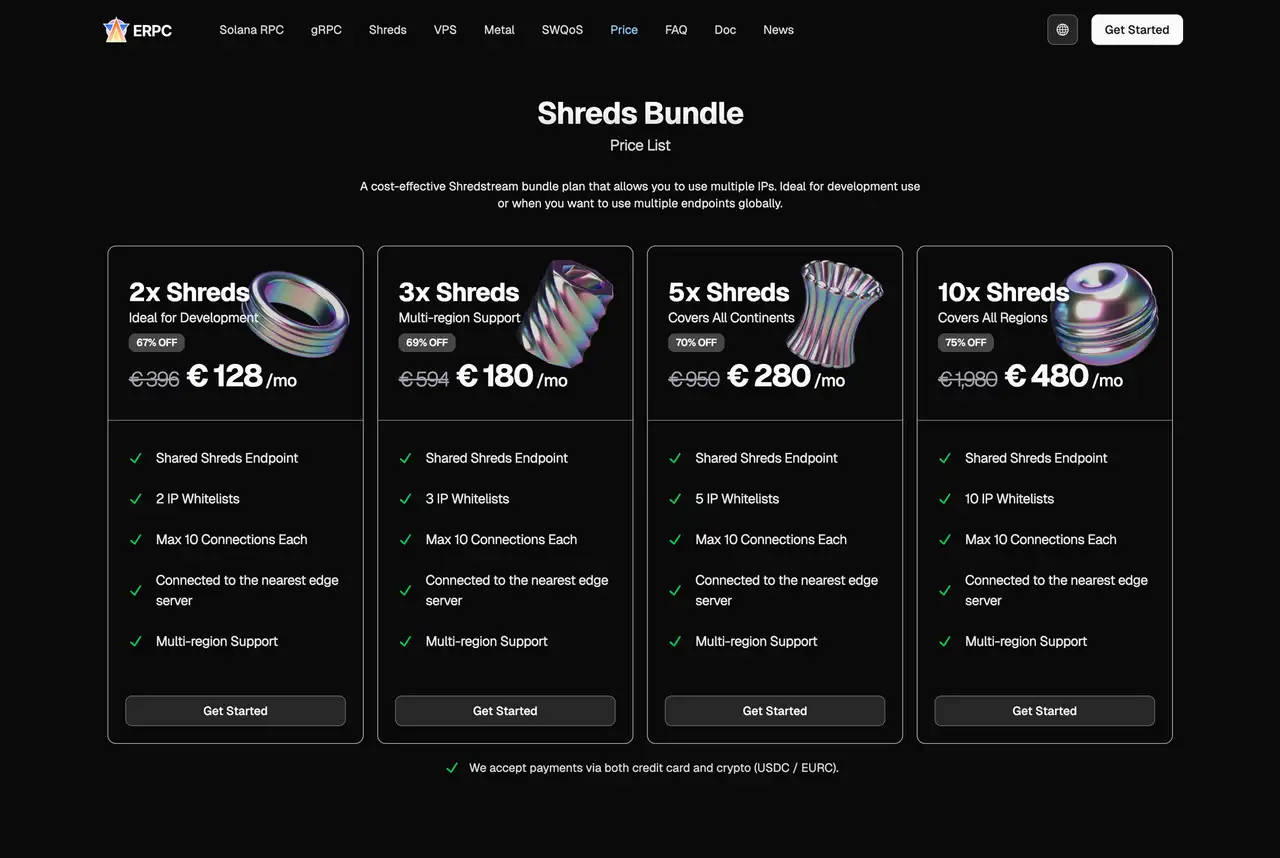
In addition to single-region deployments, ERPC’s Shredstream is available through configurations and bundle plans designed for multi-region usage. In Solana, block leaders rotate across regions worldwide, meaning that no single region consistently represents the shortest or most optimal acquisition point.
A multi-region configuration enables simultaneous observation and acquisition of Shreds from multiple locations, ensuring that data can be received from the region with the best conditions at any given moment. This approach avoids locking into time-of-day, geographic, or network-path disadvantages and keeps acquisition conditions as close as possible to the shortest path at all times.
Accessing Shreds at a layer earlier than Geyser gRPC makes it possible to secure this optimal acquisition point sooner, representing a fundamental advantage in low-latency system design.
Positioning and Use Cases for UDP Raw Shreds
For advanced professional use cases that demand extremely low latency, ERPC continues to recommend UDP Forwarding (Raw Shreds). UDP-based Shreds reception closely matches the wire format used between Solana validators and minimizes protocol overhead.
At the same time, Shredstream—including shared configurations—offers an excellent balance between implementation effort and performance, delivering sufficiently high speed and stability for most use cases. A practical approach is to begin with Shredstream and transition to UDP Raw Shreds when pushing the limits of initial response speed. In all cases, Shreds are pre-finalization data and must be handled with the assumption of possible loss or out-of-order delivery.
Pricing and Bundle Plans
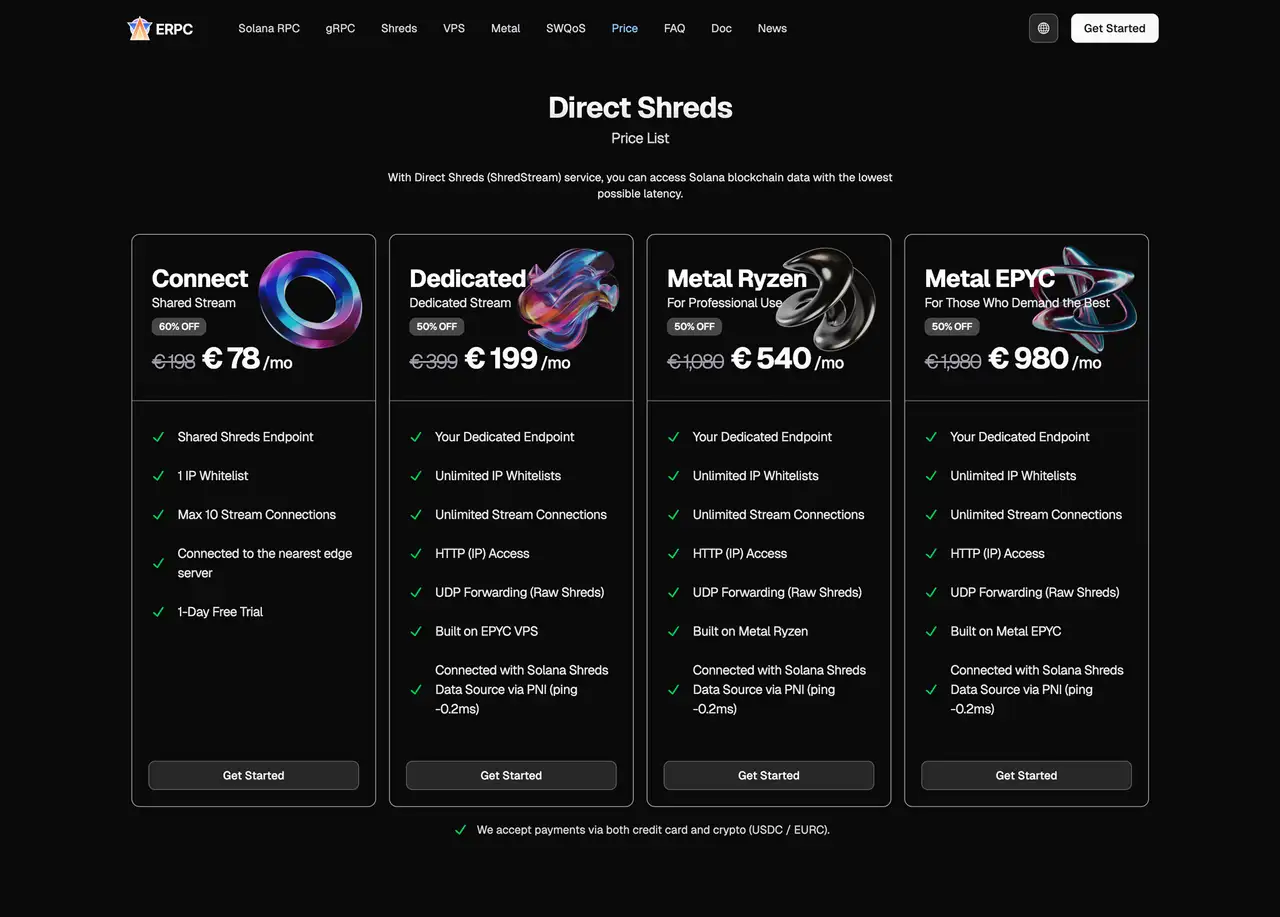
Please refer to the following pricing tables for Shredstream plans and the multi-region bundle offerings. Bundle plans are designed to make multi-region acquisition practical and cost-effective.
Inquiries and Consultation
For questions regarding Shredstream adoption, multi-region configurations, migration planning to UDP Raw Shreds, or current availability, please contact us via the Validators DAO official Discord.
Validators DAO Official Discord: https://discord.gg/C7ZQSrCkYR
ERPC Official Website: https://erpc.global/en
ERPC Official Website: https://erpc.global/en
News