
ERPC to Apply New Pricing for Solana Products from February 2026. January 2026 Marks the Final Month to Start Contracts at Open Pricing
ERPC to Apply New Pricing for Solana Products from February 2026. January 2026 Marks the Final Month to Start Contracts at Open Pricing
ELSOUL LABO B.V. (Headquarters: Amsterdam, Netherlands; CEO: Fumitake Kawasaki), together with Validators DAO, announces that ERPC will begin applying new pricing to its Solana infrastructure services starting in February 2026.
Ahead of this change, January 2026 is designated as the “Open Pricing Last Sale” period. During this month, new contracts and free trials for ERPC services may still be started at the current open pricing.
For users who begin contracts during January 2026, as well as those with existing subscriptions, the same pricing will be maintained for as long as the contract remains active.
For users who begin contracts during January 2026, as well as those with existing subscriptions, the same pricing will be maintained for as long as the contract remains active.
Open Pricing Adopted by ERPC
Since its public launch in 2024, ERPC has consistently provided all services under an open pricing model.
In Solana use cases such as RPC, gRPC, Shredstream, transaction submission, and real-time analytics, results are determined by factors that cannot be evaluated through isolated benchmarks or theoretical performance alone.
Reproducible improvement cannot be achieved without accounting for real operational conditions, including momentary peak loads, external disturbances, regional and routing variance, and fluctuations in connection volume.
Reproducible improvement cannot be achieved without accounting for real operational conditions, including momentary peak loads, external disturbances, regional and routing variance, and fluctuations in connection volume.
For this reason, ERPC has positioned the continuous flow of real traffic through its network—enabled by broad user participation—as an integral part of its research and development process.
Research and Quality Improvement Based on Real Traffic
Through open pricing, ERPC has attracted a wide range of use cases.
Traffic from bots, DeFi applications, trading systems, indexers, backend processing, and monitoring workloads—each with different load characteristics and active periods—has converged simultaneously, making it possible to identify bottlenecks and instability that would not surface in single-purpose environments.
Traffic from bots, DeFi applications, trading systems, indexers, backend processing, and monitoring workloads—each with different load characteristics and active periods—has converged simultaneously, making it possible to identify bottlenecks and instability that would not surface in single-purpose environments.
Based on these observations, ERPC has progressively improved the following areas:
- Optimization of network paths and edge placement
- Stabilization of gRPC and Shreds stream processing
- Improvements to proxy and control-layer implementations
- Establishment of operational policies designed to prevent degradation under congestion
These improvements were not developed in isolation, but validated and optimized holistically through continuous real-world operation.
Current State and Evaluation
As a result, ERPC is now selected by users who prioritize latency, stability, and reproducibility as an industry-leading Solana RPC platform.
What matters is that this state is not the outcome of temporary campaigns or specific test conditions, but one that remains resilient under continuous real-world operation.
ERPC bases its design and operations not on theoretical values, but on practical results observed in production environments.
ERPC bases its design and operations not on theoretical values, but on practical results observed in production environments.
Changes in the External Environment Since 2024
At the same time, the infrastructure landscape has changed significantly since 2024.
Driven by the rapid expansion of AI and blockchain demand, global demand for server hardware—including CPUs, ECC memory, NVMe storage, and network equipment—has increased substantially.
In particular, rising memory prices have made procurement of high-performance configurations increasingly difficult.
In particular, rising memory prices have made procurement of high-performance configurations increasingly difficult.
The requirements for Solana workloads exceed those of general-purpose servers, and maintaining the same quality level in procurement has become challenging.
Hardware costs continue to rise, and this structural trend is not expected to resolve in the short term.
Hardware costs continue to rise, and this structural trend is not expected to resolve in the short term.
ERPC’s Decision Not to Compromise Performance
A large portion of ERPC users choose the platform specifically for performance.
Usage trends clearly show that these users make decisions based on comparative testing and measured results.
Usage trends clearly show that these users make decisions based on comparative testing and measured results.
Accordingly, ERPC will not pursue options such as migrating to lower-performance servers, adopting configurations prone to degradation under congestion, or compromising operational policies in response to rising costs.
ERPC maintains the fundamental principle that quality and performance will not be sacrificed.
ERPC maintains the fundamental principle that quality and performance will not be sacrificed.
Transition to Sustainable Operations and the Pricing Update Decision
Through open pricing, ERPC has advanced its research and quality improvement phase and has now established sufficient real-world operational data and validation environments.
At the same time, changes in the external environment have clarified the cost structure required to maintain high-quality configurations.
To continue prioritizing performance while sustaining ongoing investment and improvement, a transition to a sustainable pricing model is necessary.
To continue prioritizing performance while sustaining ongoing investment and improvement, a transition to a sustainable pricing model is necessary.
Based on these considerations, ERPC has decided to apply new pricing starting in February 2026.
January 2026: Open Pricing Last Sale
January 2026 will be the final month in which contracts can be started under open pricing.
For contracts initiated during this month, as well as for existing subscriptions, pricing will remain unchanged for the duration of the active contract.
For contracts initiated during this month, as well as for existing subscriptions, pricing will remain unchanged for the duration of the active contract.
How to Check the New Pricing
Examples of the new pricing are shown in the following price lists:
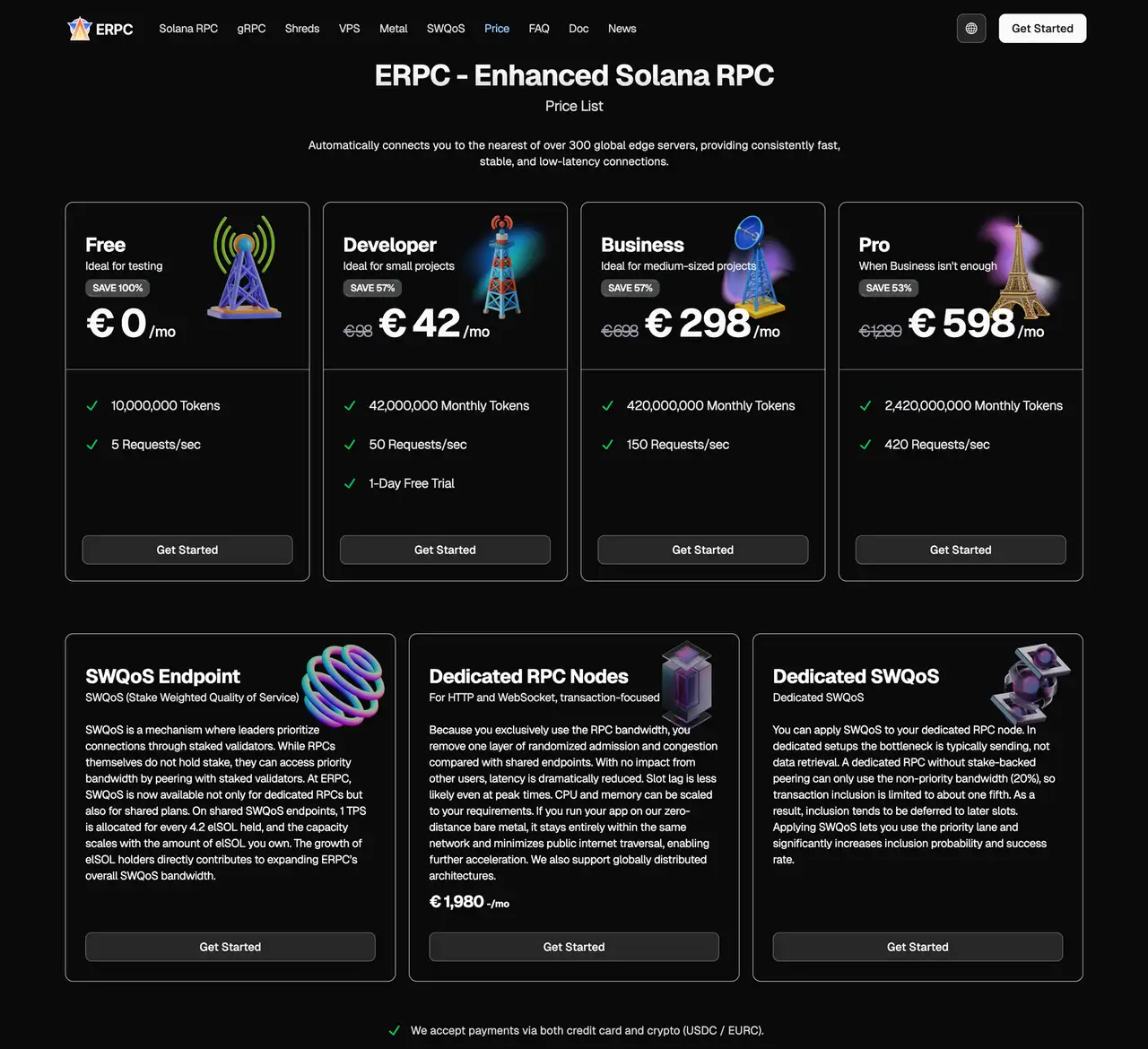
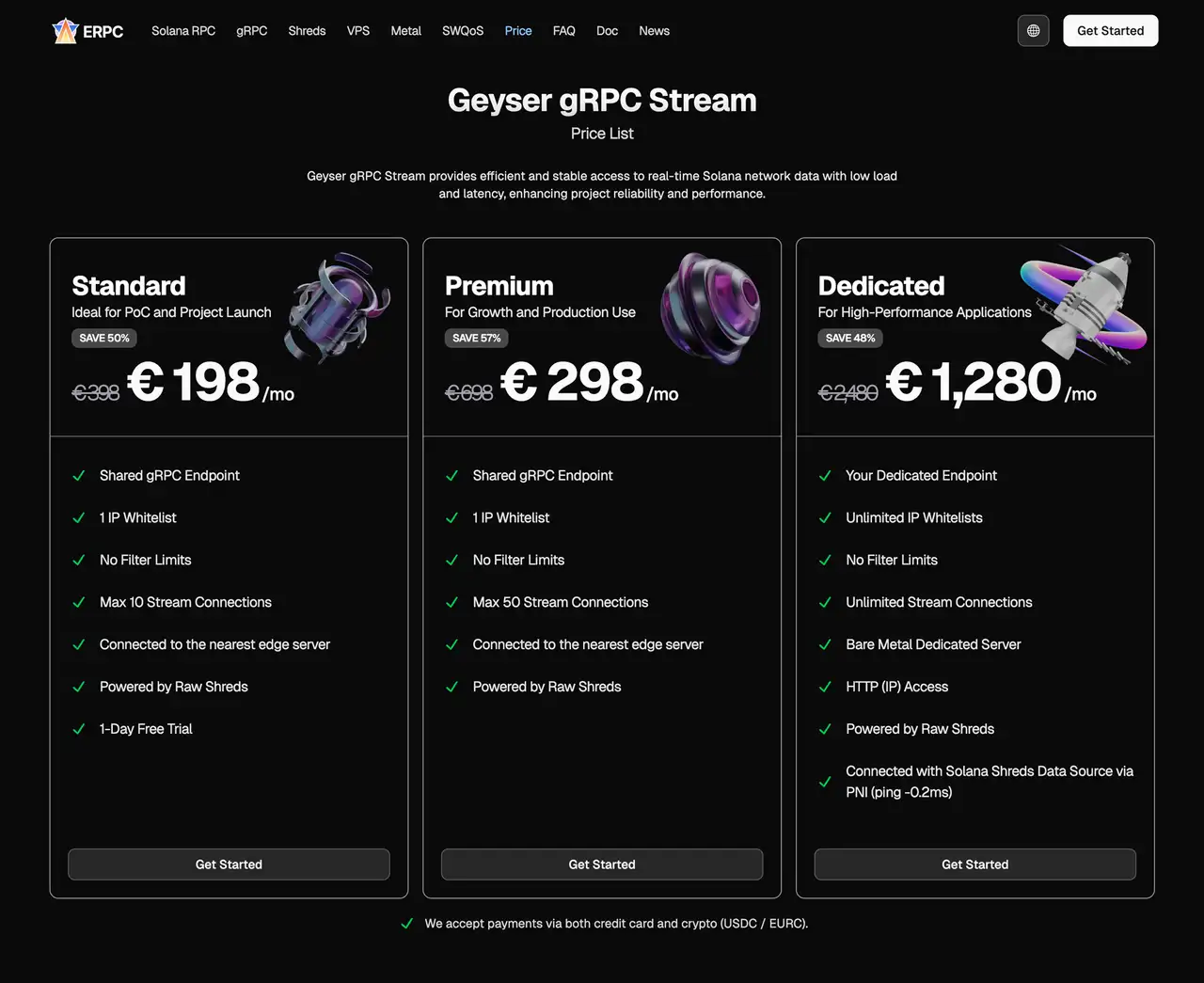
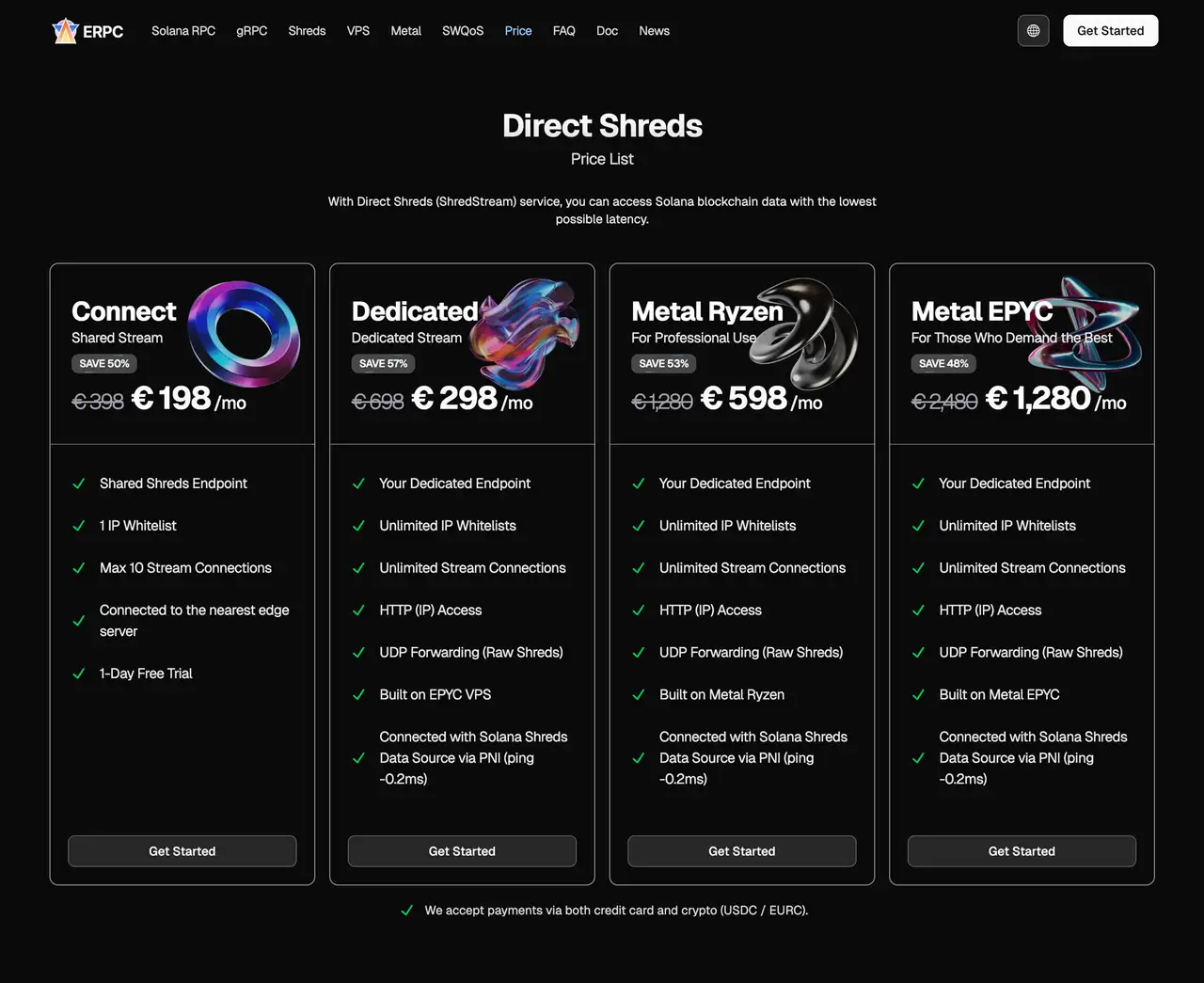
For full details and the latest pricing across all services, please refer to the following page:
Contracts, Free Trials, and Consultations
During the Open Pricing Last Sale period, confirmation of current pricing, contract initiation, free trials, and configuration consultations are available via the Validators DAO official Discord.
Validators DAO Official Discord: https://discord.gg/C7ZQSrCkYR
ERPC Official Website: https://erpc.global/en
ERPC Official Website: https://erpc.global/en
ERPC sincerely thanks all users for their continued support.
News