
SLV v0.13 Released — The CLI Era Is Over: Solana Development Shifts to AI Agent Dialogue
SLV v0.13 Released — The CLI Era Is Over: Solana Development Shifts to AI Agent Dialogue
ELSOUL LABO B.V. (Headquarters: Amsterdam, Netherlands; CEO: Fumitake Kawasaki) and Validators DAO have released v0.13 of SLV, the open-source Solana development toolkit.
After installation, run
slv onboard to set up the environment, then slv c to launch the AI Console. That is all it takes to begin managing Solana validators, RPC nodes, and application development entirely through natural language. There is no need to manually write MCP configuration files or look up and register endpoints.This release marks a turning point: the primary interface for Solana development and operations shifts from CLI-centric workflows to dialogue with AI agents.
SLV Website: https://slv.dev/en
Getting Started: https://slv.dev/en/doc/general/getting-started/
SLV — The AI Agent Kit for Solana Devs
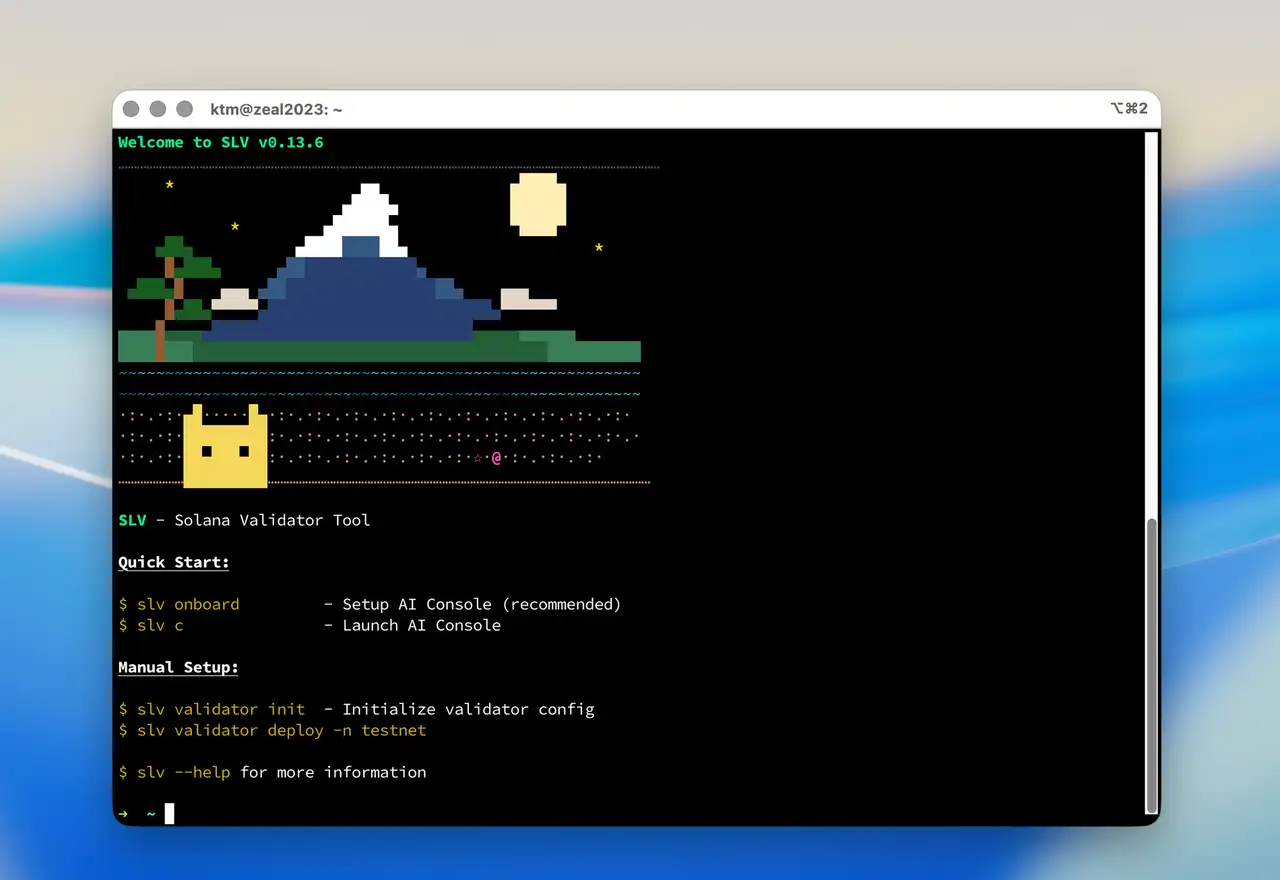
SLV is the AI Agent Kit for Solana developers. It provides a unified, open-source operational foundation covering validators, RPC, Geyser gRPC, and application development — with every method fully MCP (Model Context Protocol) compatible.
v0.13 radically simplifies access to this MCP-ready foundation. Simply complete the onboarding wizard, and every SLV method becomes executable through an AI agent. MCP configuration, key access, version tracking — operational concerns that previously required separate handling now converge into a single interface.
Why This Release Is a Turning Point
MCP Setup Is Inherently Tedious
Leveraging AI agents for Solana infrastructure operations requires MCP server configuration, endpoint registration, credential management, and tool selection — all before a single useful command can be issued. These steps are cumbersome even for experienced developers and have been a primary obstacle for those wanting to explore AI-assisted operations.
SLV v0.13 eliminates this barrier entirely. The
slv onboard wizard walks through AI provider connection, model selection, skill configuration, and API key registration in a single guided flow. No hand-editing config files, no looking up endpoints.Secure Key Management, Built In
Solana validator operations require precise handling of multiple keys: identity, vote account, and authority keys. SLV's AI agent accesses these keys securely from the local environment by design — no need to specify paths each time or transmit keys externally.
Structurally reducing cognitive load without compromising security. That is SLV's design principle.
AI Console — Just Tell It What You Need
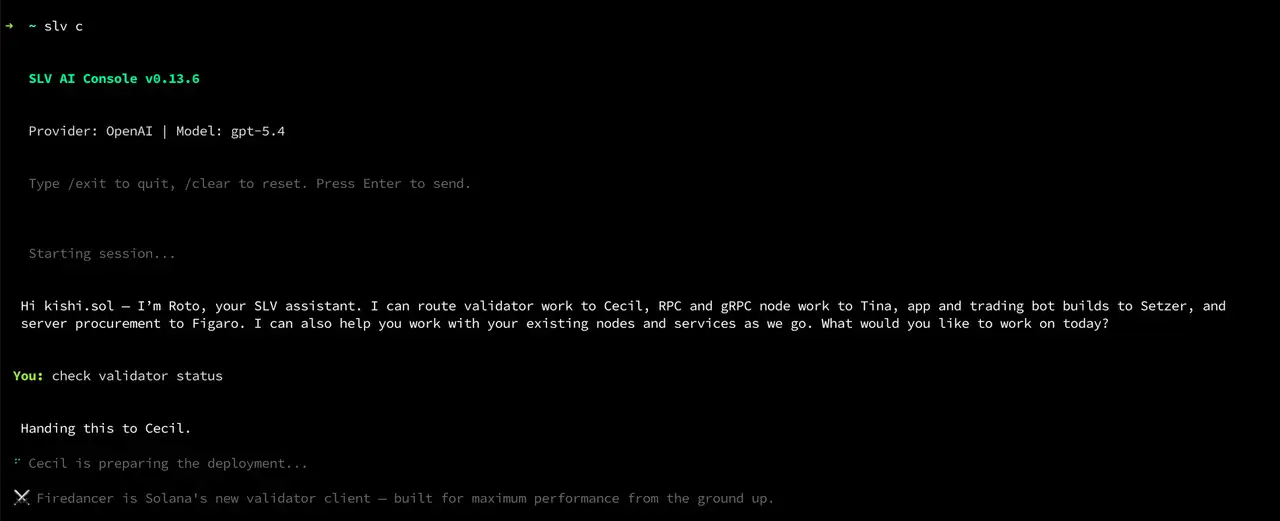
The AI Console, launched with
slv c, is SLV's core interface.Deploying validators, upgrading, downgrading, switching identities, building RPC nodes, configuring Geyser gRPC, scaffolding application projects — all of these can be executed simply by telling the AI agent what you need in natural language.
No need to memorize CLI flags. No need to search documentation. State your intent, and the AI agent directly operates SLV's MCP-compatible toolset, selecting and executing the appropriate steps. Requests are automatically routed to specialized agents handling validator operations, RPC and Geyser configuration, application development, and server procurement.
Automatic Update Checks on Launch
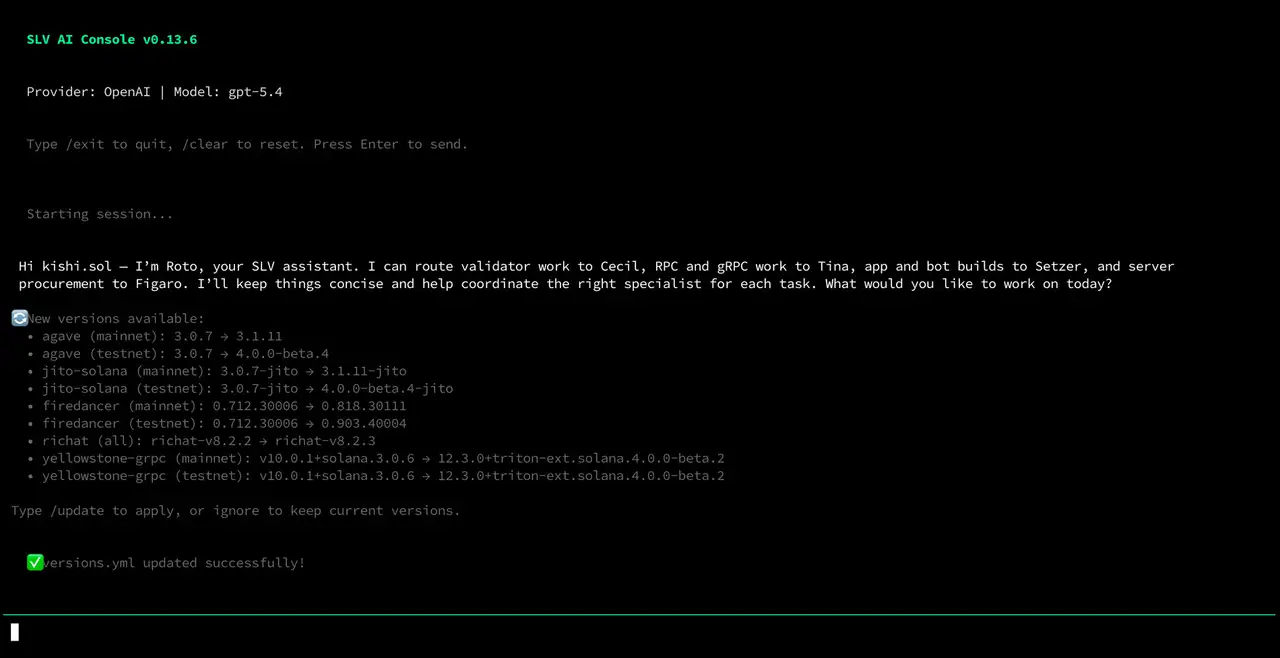
On startup, the AI Console automatically fetches the latest versions of agave, jito-solana, firedancer, yellowstone-grpc, and other components, displaying available updates at a glance. To apply updates, simply type
/update. The AI agent handles version verification and application.Solana is currently undergoing frequent version changes and rollbacks as part of the v3 upgrade cycle. The AI Console structurally absorbs this operational burden.
The Hidden Cost of Cognitive Load
In validator operations, downtime directly impacts revenue. Accurately assessing the situation and entering the right command at the right time — this task appears simple on the surface but is, in practice, extraordinarily draining.
Unlike typical application development, every single command in validator operations carries outsized weight. One input error, one oversight can directly degrade network quality or affect stakers. This cognitive load has long been an overlooked cost of validator operations.
Natural language interaction through AI agents structurally removes the burden of recalling exact command syntax, cross-referencing procedure documentation, and tracking differences between versions. This is not merely a UX improvement. Lower cognitive load means fewer judgment errors and fewer operational mistakes, which translates directly into reduced downtime and improved network quality.
In our own operations, once we adopted natural language workflows for expressing intent, reverting to the conventional flow of recalling command syntax and procedures step by step became difficult. The difference in cognitive load directly becomes a difference in operational quality. AI agents support an environment where operators can focus on what truly matters — network strategy, performance optimization, and stake growth.
Structurally Lowering the Barrier to Solana Validation
What SLV v0.13 achieves is not simply easier operations. It structurally lowers the barrier to entry for the Solana network itself.
Running a Solana validator has traditionally required deep Linux knowledge, CLI proficiency, understanding of Solana-specific configuration files, and judgment for version management. These prerequisites have been a barrier for business professionals and organizations without specialized technical expertise.
With SLV v0.13, access to operational knowledge and execution pathways are dramatically improved through AI agents. The AI agent references necessary knowledge via MCP and automatically assembles and executes the appropriate steps. Even without specialized technical expertise, the path from initial validator setup through day-to-day operations is now open. What the AI agent lowers is the barrier to entry and the cognitive load of daily operations; decision-making as the operating entity remains with the operator, as it always has.
The quality of the Solana network directly depends on the number and diversity of its validators. Lowering barriers so that more organizations can participate as validators means strengthening the network's overall decentralization and resilience.
The CLI Remains — Options for Every Stage of Growth
While AI agent dialogue is becoming SLV's primary interface, the CLI tooling that forms the backbone of development remains fully available.
SLV's CLI delivers practical operational capabilities in an accessible form. When a growing project requires managing multiple servers, Ansible-based reproducible environment construction is available. Inventory file-based multi-node management, playbook-driven batch deployment and updates — the architecture is built for large-scale operations.
SLV's predecessor is solv, developed by Epics DAO. We understand that the straightforward style of installing directly on a node and managing a single node has enduring appeal. We are working to make local execution options available for users who value this ease of use.
AI agents, direct CLI execution, Ansible-based multi-node management — choose the approach that fits your scale and operational style.
ChatGPT and Claude Supported
SLV v0.13 officially supports ChatGPT (OpenAI) and Claude (Anthropic) as AI providers. In the
slv onboard wizard, simply select your preferred AI and model to complete the connection.Regardless of which AI you normally use, SLV's AI agent environment is ready for you.
The Era of Distributed Placement — ASN Concentration Now Matters on Solana
The Solana Foundation is tightening ASN and data center concentration limits as part of its delegation program requirements. When validators are overly concentrated within a specific ASN or data center, Foundation stake delegation is restricted.
This policy is a structural measure to strengthen the Solana network's decentralization and fault tolerance. At the same time, it means validator operators must now consider not only whether they can run a node, but where — under which ASN, in which data center, and with what placement strategy.
ELSOUL LABO B.V. has been assigned its own ASN (AS200261) by RIPE NCC and is moving forward with opening a Solana-specialized top-tier data center. The facility features hardware unified on the latest generation AMD EPYC 5th Gen, AMD Threadripper PRO 5th Gen (9975WX and equivalent), and NVMe Gen 5, combined with optimized network routing through our own ASN. Opening is scheduled for next month.
This is not simply a data center initiative. As ASN concentration limits tighten, holding an independent ASN and the ability to design placement strategies independently is directly tied to the sustainability of validator operations. And to practically sustain distributed placement over time, an automated foundation for provisioning, configuration, updates, and migration is essential. The operational orchestration SLV provides is precisely the answer to this challenge.
From standing up a node to deciding where and how to place it, and how to sustain its operation over time — SLV and ERPC will cover the full scope of what Solana operations demand going forward.
Open Source
SLV continues to be provided as open source. Validator operations, RPC infrastructure, application development — everyone involved in Solana operations can use SLV's AI agent environment at no cost.
From installation to natural language operations, it takes only minutes.
SLV GitHub: https://github.com/validatorsDAO/slv
ERPC — The Solana Infrastructure Platform That Works with SLV
Deploying environments built with SLV on the ERPC platform provides the fastest communication conditions, Solana-specialized tuning, and zero-distance communication with platform services from the start.
Solana RPC, Solana Geyser gRPC, Solana Shredstream, bare metal servers, VPS, Global Storage — everything is integrated within a single platform. The combination of SLV's AI agents and ERPC provides the fastest and most operationally accessible foundation for Solana development.
ERPC Website: https://erpc.global/en
Five Consecutive Years of WBSO Approval
ELSOUL LABO has received approval under the Netherlands' WBSO R&D incentive program for five consecutive years since 2022. The 2026 approved research project includes "Research and development on validator placement and operational orchestration automation," and SLV v0.13's AI agent integration is the direct realization of this research theme.
Research hypotheses become implementations, tested under real operational constraints, and the challenges discovered feed back into the next cycle of research. SLV continues to evolve within this loop.
Contact
For inquiries about SLV and ERPC, please create a support ticket on the official Validators DAO Discord.
Validators DAO Discord: https://discord.gg/C7ZQSrCkYR
Links
- SLV Website: https://slv.dev/en
- SLV Getting Started: https://slv.dev/en/doc/general/getting-started/
- SLV GitHub: https://github.com/validatorsDAO/slv
- ERPC Website: https://erpc.global/en
- Validators DAO Discord: https://discord.gg/C7ZQSrCkYR
News